Sisters in the Struggle by Bettye Collier-Thomas & V. P. Franklin
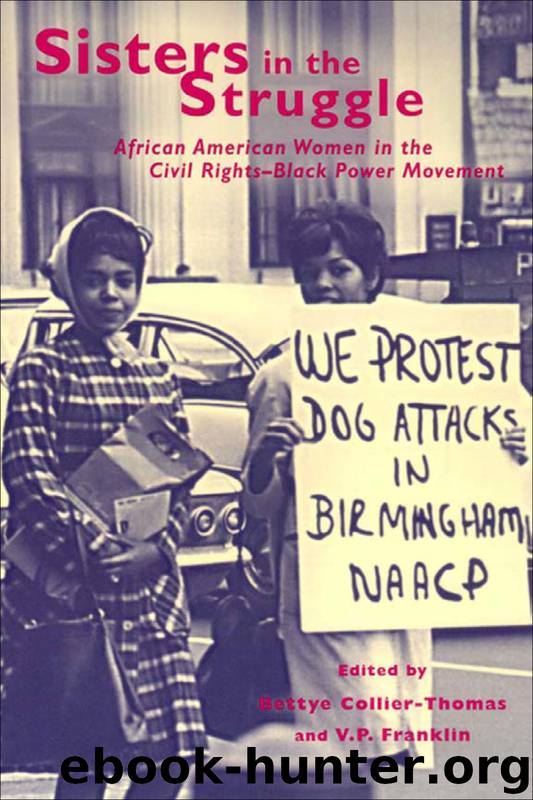
Author:Bettye Collier-Thomas & V. P. Franklin
Language: eng
Format: epub
Publisher: New York University Press
Published: 2001-05-14T16:00:00+00:00
NOTES
1. Wells Barnett’s quote is cited in Paula Giddings, When and Where I Enter: The Impact of Black Women on Race and Sex in America (New York: William Morrow, 1984), 23. Wells Barnett and Gloria Richardson are examples of radical black female activists who have claimed the right to defend themselves and their communities. Kathleen Cleaver, “Racism, Civil Rights, and Feminism,” in Adrien Katherine Wing, ed., Critical Race Feminism: A Reader (New York: New York University Press, 1997), 36.
2. Cleveland Sellers (with Robert Terrell), The River of No Return: The Autobiography of a Black Militant and the Life and Death of SNCC (Jackson: University of Mississippi Press, 1973) wrote about Richardson’s courageous leadership of the Cambridge movement. However, in one of the two pages in which Clayborne Carson mentions Gloria Richardson, she appears as part of a larger discussion of SNCC organizer Bill Hall. See Carson’s In Struggle: SNCC and the Black Awakening of the 1960s (Cambridge: Harvard University Press, 1981), 72. A fuller account of Richardson’s civil rights activism appears in two recent publications devoted exclusively to the role of black women in the Civil Rights Movement, including Belinda Robnett, How Long? How Long? African-American Women in the Struggle for Civil Rights (New York: Oxford University Press, 1997) and Annette K. Brock, “Gloria Richardson and the Cambridge Movement” in Vicki L. Crawford, Jacqueline A. Rouse, and Barbara Woods, eds., Women in the Civil Rights Movement: Trailblazers and Torch-bearers, 1941–1965 (Bloomington: Indiana University Press, 1993), 121–44; and Edward Trever, “Gloria Richardson and the Cambridge Civil Rights Movement, 1962–1964” (M.A. thesis, Morgan State University, 1994). Biographical entries and short essays about Richardson include: Kathleen Thompson, “Gloria Richardson,” in Darlene Clark Hine, Elsa Barkley Brown, and Rosalyn Terborg-Penn, eds., Black Women in America: An Historical Encyclopedia (Brooklyn, NY: Carlson Publishing, 1993), II, 980–82; Annette K. Brock, “Gloria Richardson” in Jessie Carney Smith, ed., Notable Black American Women (Detroit, MI: Gale Research, 1992), 938–40; Melanie B. Cook, “Gloria Richardson: Her Life and Work in SNCC,” Sage: A Scholarly Journal on Black Women, Student Supplement (1998): 51–53; Anita K. Foeman, “Gloria Richardson: Breaking the Mold,” Journal of Black Studies 26 (May 1996): 604–15; and Sandra Y. Millner, “Recasting Civil Rights Leadership: Gloria Richardson and the Cambridge Movement,” Journal of Black Studies 26 (July 1996): 668–87.
3. Foeman, “Gloria Richardson,” 604–5.
4. Historian Gerda Lerner documented the history of black female activism beginning in the early nineteenth century in Black Women in White America: A Documentary History (New York: Random House, 1972). Black female activism is explored in Sharon Harley and Rosalyn Terborg-Penn, eds., The Afro-American Woman: Struggles and Images, 2d ed., (Baltimore, MD: Black Classic Press, 1998), and Paula Giddings, When and Where I Enter, passim.
5. Peter B. Levy, “Civil War on Race Street: The Black Freedom Struggle and White Resistance in Cambridge, Maryland, 1960–1964,” Maryland Historical Magazine 89 (Fall 1994): 291–318.
6. Jenny Walker, “The ‘Gun-Toting’ Gloria Richardson: Black Violence in Cambridge, Maryland,” in Peter J. Ling and Sharon Monteith, eds., Gender and the Civil Rights Movement (New York: Garland Publishing, 1999), 169–86.
Download
This site does not store any files on its server. We only index and link to content provided by other sites. Please contact the content providers to delete copyright contents if any and email us, we'll remove relevant links or contents immediately.
| Anthropology | Archaeology |
| Philosophy | Politics & Government |
| Social Sciences | Sociology |
| Women's Studies |
The Secret History by Donna Tartt(19466)
The Social Justice Warrior Handbook by Lisa De Pasquale(12292)
Thirteen Reasons Why by Jay Asher(9115)
This Is How You Lose Her by Junot Diaz(7054)
Weapons of Math Destruction by Cathy O'Neil(6465)
Zero to One by Peter Thiel(5946)
Beartown by Fredrik Backman(5930)
The Myth of the Strong Leader by Archie Brown(5623)
The Fire Next Time by James Baldwin(5579)
How Democracies Die by Steven Levitsky & Daniel Ziblatt(5321)
Promise Me, Dad by Joe Biden(5228)
Stone's Rules by Roger Stone(5185)
A Higher Loyalty: Truth, Lies, and Leadership by James Comey(5082)
100 Deadly Skills by Clint Emerson(5023)
Rise and Kill First by Ronen Bergman(4890)
Secrecy World by Jake Bernstein(4873)
The David Icke Guide to the Global Conspiracy (and how to end it) by David Icke(4845)
The Doomsday Machine by Daniel Ellsberg(4618)
The Farm by Tom Rob Smith(4609)
